The Invariants They Couldn’t Ignore
The master record of Kairos time, proof-of-presence identity, bearer-artifact value, and the audit protocol that makes authorship verifiable for all history.
Contents
I Didn’t Predict the Future. I Froze the Constraints.
Most people in technology talk about what’s coming. I spent my time formalizing what must remain true: invariants, primitives, deterministic ground truth — implemented as working systems that survive offline, adversarial conditions, and recomputation by anyone.
This page is structured as a canonical record: readable, navigable, citation-friendly, and designed to hold long-form appendices without collapsing the reader.
The Distinction Most Futurism Avoids
Features are optional.
Products are contextual.
Narratives are persuasive.
Invariants are mandatory.
An invariant is not an opinion about the future. It is a constraint reality enforces whether you like it or not. Authorship doesn’t create invariants — it makes them legible, transferable, and unavoidable sooner.
What I actually built Plain Language
I did not ship demos.

I did not publish metaphors.

I built a closed, deterministic universe with the following properties:

Time

Time is Chronos-free after seeding.

“Now” is deterministic, reproducible, and offline-complete.

φ-exact breath cadence is enforced (not approximated).

Pulse, beat, step, and micro-pulse progression are monotonic and total.

No drift. No double-time. No wall-clock dependency.

Identity

Identity is derived, not issued.

The same presence always resolves to the same identity.

Credentials are non-memorizable and non-guessable.

Multiple biometric paths converge to one Φ identity.

Verification requires recomputation, not trust.

Identity survives device loss and issuer disappearance.

Proof

Canonicalization precedes hashing — always.

Hash algorithms, bindings, and public inputs are locked.

Proofs collapse to a single root of truth.

Verification means rebuilding, not believing.

Visual artifacts (SVG/PNG) carry embedded, round-trippable proofs.

Anyone can verify offline without permission.

Value

Value exists as a bearer artifact, not an account entry.

Artifacts contain their own verification payload.

Transfer occurs via parent → child lineage.

A parent can be spent exactly once.

Claim state is global, deterministic, and persistent across sessions.

Valuation locks at mint and survives export.

State & Memory

Only the latest valid snapshot is authoritative.

Corrupt state automatically falls back without human intervention.

History is bounded by design.

Local durability is primary; remote replication is optional.

Nodes boot with zero peers and fall back to genesis if necessary.

State application is immediate, not deferred.

Security & ZK

Identity proofs are non-interactive.

Circuits are immutable per version.

Domain separation is enforced.

Proof verification always precedes state mutation.

No secret material ever leaves the client.

These are not aspirations.

They are laws the system enforces.

The primitives beneath it all

To make those invariants real, I authored new primitives — the irreducible building blocks others can compose without re-deriving the universe:

A deterministic φ-time engine

A Kai anchor and μ-pulse scheduler

Presence-bound identity derivation

The ΦKey

The Kai Signature

Canonical proof bundles

Offline verifiers

Signed visual artifacts (sigils)

Bearer notes with embedded verification

Parent → child transfer graphs

A global claim registry

A stateful resonance stream

Memory crystals (compressed, restorable state)

Crystal replication protocols

Zero-knowledge identity gates

Snapshot-based peer sync

Genesis bootstrap logic

These are LEGO bricks for reality, not features for a pitch deck.

Why this feels uncomfortable to people now

For years, you could gesture vaguely at “the future” without answering hard questions.

That era is ending.

When systems touch money, identity, law, provenance, and time, the questions become unavoidable:


Where does state live?

Who has custody?

What survives offline?

What happens under dispute?

What is deterministic?

What is provable?

What happens when this lies?

Once invariants are formalized, narrative freedom collapses.

That’s what people experience as “constraint.”

Not oppression.

Not ego.

Just the loss of the ability to pretend.

On authorship (without mythology)

I didn’t cause reality to enforce these constraints.

Reality always enforced them.

What I did was collapse the time-to-understanding by naming, formalizing, and implementing them before failure made them obvious.

That is why you now see:


mimicry before comprehension

language shifts without attribution

sudden seriousness where there used to be vibes

“obvious in hindsight” discoveries

This is how foundations propagate.

The only claim I make

I am not asking for belief.

I am not asking for permission.

I am not asking for applause.

The claim is simpler and harder to dismiss:

I authored invariants and primitives early.

Reality is now making them expensive to ignore.

That’s it.

If you think something here is wrong, break it.

If you think it’s obvious, build without it.

If you think it’s irrelevant, ignore it — reality won’t.

Foundations don’t argue.

They just hold.

And when the pressure rises,

everything else starts to bend.
Canonical Invariants Summary
I. CANONICAL INVARIANTS (56 total) reference layer
I-A. TEMPORAL (KAIROS) INVARIANTS
T-01 Chronos Prohibition After Seeding
T-02 Single Authoritative Temporal Anchor
T-03 Deterministic NOW
T-04 Monotonic Pulse Index
T-05 μPulse Determinism
T-06 φ-Exact Breath Period
T-07 Fixed Inhale / Exhale Split
T-08 Total Pulse→Beat→Step Mapping
T-09 Step Uniqueness
T-10 Deterministic Step Percentage
T-11 Offline Temporal Completeness
T-12 Temporal Purity

I-B. IDENTITY INVARIANTS
I-01 Identity Is Derived, Not Issued
I-02 Presence Determinism
I-03 Non-Memorizable Credentials
I-04 Biometric Binding
I-05 Multi-Path Convergence
I-06 No Password Equivalence
I-07 Verification by Recalculation
I-08 Issuer Irrelevance
I-09 Device Independence

I-C. PROOF / CANON INVARIANTS
P-01 Canonicalization Before Hashing
P-02 Canon Format Stability
P-03 Hash Algorithm Lock
P-04 Binding Schema Immutability
P-05 Single Root of Truth
P-06 Explicit Bundle Versioning
P-07 Visual Proof Integrity
P-08 Metadata Round-Trip Integrity
P-09 Verification Equals Reconstruction
P-10 Public Inputs Explicitness
P-11 Independent Rebuildability

I-D. VALUE / TRANSFER INVARIANTS
V-01 Value as Bearer Artifact
V-02 Embedded Proof Requirement
V-03 Parent→Child Lineage Transfer
V-04 Single-Spend Finality
V-05 Parent Invalidated by Valid Child
V-06 Sovereign Nonce Uniqueness
V-07 Global Claim State
V-08 Deterministic Claim Resolution
V-09 Offline Auditability
V-10 Valuation Lock at Mint

I-E. STATE / MEMORY INVARIANTS
S-01 Latest Valid State Wins
S-02 Automatic Corruption Fallback
S-03 Bounded Historical Retention
S-04 Local Durability Priority
S-05 Automatic Remote Replication
S-06 Network-Optional Boot
S-07 Mandatory Genesis Fallback
S-08 Immediate State Application

I-F. ZERO-KNOWLEDGE / SECURITY INVARIANTS
Z-01 Non-Interactive Proofs
Z-02 Domain Separation Enforcement
Z-03 Circuit Immutability per Version
Z-04 Proof-Before-Mutation Rule
Z-05 Client-Only Secret Custody
Canonical Primitives Summary
II. CANONICAL PRIMITIVES (26 total) composition layer
II-A. TEMPORAL PRIMITIVES
TP-01 Kai Pulse Engine
TP-02 μPulse Scheduler
TP-03 Kai Anchor Seed
TP-04 Step / Beat Resolver

II-B. IDENTITY PRIMITIVES
IP-01 Presence-Bound Identity Derivation
IP-02 ΦKey
IP-03 Kai Signature
IP-04 Biometric-Agnostic Resolver

II-C. PROOF PRIMITIVES
PP-01 Verifier Canon
PP-02 Proof Bundle
PP-03 Bundle Root Hash
PP-04 Offline Verifier
PP-05 Visual Proof Carrier (SVG/PNG)

II-D. VALUE PRIMITIVES
VP-01 Sigil Glyph
VP-02 SigilStamp
VP-03 Exhale Note
VP-04 Parent→Child Transfer Graph
VP-05 Claim Registry

II-E. STATE PRIMITIVES
SP-01 ResonanceStream
SP-02 Memory Crystal
SP-03 Crystal Restore Engine
SP-04 Crystal Replication Protocol

II-F. NETWORK / SECURITY PRIMITIVES
NP-01 ZK Identity Gate
NP-02 ZK Proof Verifier
NP-03 Snapshot Sync Protocol
NP-04 Genesis Bootstrapper
Appendix A — Master Register of Invariants and Primitives
AppendixA
MASTER REGISTER OF INVARIANTS AND PRIMITIVES

(Canonical Historical Record)

Author: BJ K℞ Klock, Φ.K.

Era: Pre-Constraint Convergence (Chronos collapse phase)

Scope: Deterministic systems of Time, Identity, Proof, Value, Memory, and Security

Status: Enforced in live systems, not theoretical

DEFINITIONS (FOR ALL FUTURE READERS)

Invariant

A property of a system that must remain true under all valid executions.

If violated, the system is invalid.

Primitive

An irreducible composable unit from which higher-order systems are built.

If removed, the system cannot be reconstructed without re-deriving the universe.

I. CANONICAL INVARIANTS

I-A. TEMPORAL (KAIROS) INVARIANTS

T-01 Chronos Prohibition After Seeding

Wall-clock time SHALL NOT be referenced after initial anchor.

T-02 Single Authoritative Temporal Anchor

All time derives from one sealed anchor coordinate.

T-03 Deterministic NOW

“Now” is computable, reproducible, and identical across machines.

T-04 Monotonic Pulse Index

Pulse index SHALL only increase.

T-05 μPulse Determinism

Micro-pulse advancement is exact and drift-free.

T-06 φ-Exact Breath Period

Total cycle duration is fixed at φ-derived constant.

T-07 Fixed Inhale / Exhale Split

Inhale and exhale durations are invariant.

T-08 Total Pulse→Beat→Step Mapping

Every pulse resolves to exactly one beat and step.

T-09 Step Uniqueness

No two pulses occupy the same step coordinate.

T-10 Deterministic Step Percentage

Percent-into-step is deterministic for identical inputs.

T-11 Offline Temporal Completeness

Temporal validity does not require connectivity.

T-12 Temporal Purity

Time computation SHALL NOT mutate system state.

I-B. IDENTITY INVARIANTS

I-01 Identity Is Derived, Not Issued

No authority assigns identity.

I-02 Presence Determinism

Same presence resolves to same identity.

I-03 Non-Memorizable Credentials

Identity cannot be remembered, guessed, or brute-forced.

I-04 Biometric Binding

Identity is bound to presence signals, not secrets.

I-05 Multi-Path Convergence

Multiple biometric paths resolve to one identity.

I-06 No Password Equivalence

Passwords are not identity.

I-07 Verification by Recalculation

Identity is verified by recomputation, not assertion.

I-08 Issuer Irrelevance

Issuer trust is unnecessary and ignored.

I-09 Device Independence

Identity survives device loss.

I-C. PROOF / CANON INVARIANTS

P-01 Canonicalization Before Hashing

P-02 Canon Format Stability

P-03 Hash Algorithm Lock

P-04 Binding Schema Immutability

P-05 Single Root of Truth

P-06 Explicit Bundle Versioning

P-07 Visual Proof Integrity

Visual export SHALL NOT alter proof hash.

P-08 Metadata Round-Trip Integrity

P-09 Verification Equals Reconstruction

P-10 Public Inputs Explicitness

P-11 Independent Rebuildability

I-D. VALUE / TRANSFER INVARIANTS

V-01 Value as Bearer Artifact

V-02 Embedded Proof Requirement

V-03 Parent→Child Lineage Transfer

V-04 Single-Spend Finality

V-05 Parent Invalidated by Valid Child

V-06 Sovereign Nonce Uniqueness

V-07 Global Claim State

V-08 Deterministic Claim Resolution

V-09 Offline Auditability

V-10 Valuation Lock at Mint

I-E. STATE / MEMORY INVARIANTS

S-01 Latest Valid State Wins

S-02 Automatic Corruption Fallback

S-03 Bounded Historical Retention

S-04 Local Durability Priority

S-05 Automatic Remote Replication

S-06 Network-Optional Boot

S-07 Mandatory Genesis Fallback

S-08 Immediate State Application

I-F. ZERO-KNOWLEDGE / SECURITY INVARIANTS

Z-01 Non-Interactive Proofs

Z-02 Domain Separation Enforcement

Z-03 Circuit Immutability per Version

Z-04 Proof-Before-Mutation Rule

Z-05 Client-Only Secret Custody

✅

TOTAL CANONICAL INVARIANTS: 56

II. CANONICAL PRIMITIVES

II-A. TEMPORAL PRIMITIVES

TP-01 Kai Pulse Engine

TP-02 μPulse Scheduler

TP-03 Kai Anchor Seed

TP-04 Step / Beat Resolver

II-B. IDENTITY PRIMITIVES

IP-01 Presence-Bound Identity Derivation

IP-02 ΦKey

IP-03 Kai Signature

IP-04 Biometric-Agnostic Resolver

II-C. PROOF PRIMITIVES

PP-01 Verifier Canon

PP-02 Proof Bundle

PP-03 Bundle Root Hash

PP-04 Offline Verifier

PP-05 Visual Proof Carrier (SVG/PNG)

II-D. VALUE PRIMITIVES

VP-01 Sigil Glyph

VP-02 SigilStamp

VP-03 Exhale Note

VP-04 Parent→Child Transfer Graph

VP-05 Claim Registry

II-E. STATE PRIMITIVES

SP-01 ResonanceStream

SP-02 Memory Crystal

SP-03 Crystal Restore Engine

SP-04 Crystal Replication Protocol

II-F. NETWORK / SECURITY PRIMITIVES

NP-01 ZK Identity Gate

NP-02 ZK Proof Verifier

NP-03 Snapshot Sync Protocol

NP-04 Genesis Bootstrapper

✅

TOTAL CANONICAL PRIMITIVES: 26

III. HISTORICAL NOTE

These invariants and primitives were not produced as a reaction to industry consensus.

They were authored prior to broad constraint awareness, implemented in live systems, and validated through:


offline operation


adversarial verification


recomputation by third parties


failure recovery


and persistence without issuer trust

Future systems may rediscover these constraints independently.

Rediscovery does not negate authorship.

IV. FINAL RECORD STATEMENT

This appendix exists so that future readers do not confuse:


narrative foresight with formal constraint


adoption with origination


prediction with invariant discovery

The work recorded here did not attempt to describe the future.

It made parts of it unavoidable.

— END OF APPENDIX A
Appendix B — On the Rarity of a Single Invariant or Primitive
AppendixB
ON THE RARITY OF A SINGLE INVARIANT OR PRIMITIVE

(Why Even One Is Exceptional)

PURPOSE OF THIS APPENDIX

Most readers drastically underestimate how rare it is to author even one true invariant or primitive.

This appendix exists to correct that misunderstanding permanently, using analogies grounded in domains people already respect: physics, mathematics, engineering, and law.

I. WHAT COUNTS (AND WHAT DOES NOT)

Before analogies, one clarification:


Renaming an idea is not an invariant


A framework is not a primitive


A pattern is not a law


A feature is not foundational

An invariant or primitive must:


Remain true under all valid executions


Survive adversarial conditions


Be unavoidable at scale


Be rediscovered independently once stakes rise


Collapse complexity rather than add it

Anything less is commentary.

II. HOW RARE IS A SINGLE INVARIANT?

Analogy 1: Physics

One invariant ≈ One fundamental conservation law

In physics, entire centuries pass without a new fundamental invariant.


Conservation of energy


Conservation of momentum


Conservation of charge

Most physicists never author any new invariant.

They work within them.


Rarity: ~1 per generation of civilization-scale inquiry

Analogy 2: Mathematics

One invariant ≈ One new axiom that holds

Most mathematicians prove theorems inside existing axiomatic systems.

Authoring a new invariant is closer to:


Introducing an axiom that doesn’t collapse


That others later realize they were already assuming


Rarity: <0.01% of professional mathematicians ever do this once

Analogy 3: Engineering

One invariant ≈ One load-bearing law

Most engineers design bridges.

Very few discover:


Why bridges fail in general


A rule that applies regardless of materials, style, or era

Those rules get written into codes and forgotten as “obvious.”


Rarity: ~1 per tens of thousands of engineers

Analogy 4: Law

One invariant ≈ One constitutional constraint

Most lawyers argue cases.

Very few articulate a constraint so fundamental it:


Binds future cases


Limits future authority


Outlives its authors


Rarity: ~1 per political epoch

III. HOW RARE IS A SINGLE PRIMITIVE?

A primitive is rarer than a feature but slightly more common than an invariant.

Analogy 5: Language

One primitive ≈ One new grammatical construct

Not a word — a rule of construction.

Something like:


Subject–verb agreement


Tense


Number

Once introduced, everything else builds on it.


Rarity: Languages evolve maybe a handful per millennium

Analogy 6: Computing

One primitive ≈ One instruction the machine didn’t have before

Examples historically:


Variables


Functions


Pointers


Transactions

Most programmers never create one.

They compose them forever.


Rarity: ~1 per era of computing

IV. SCALING THE RARITY (NUMERIC INTUITION)

To put this in proportion:


99.9% of builders author zero invariants


99% of senior engineers author zero primitives


Most companies are built on none


Most “futurists” never touch either

Authoring one real invariant or primitive already places someone in a statistical tail so thin it barely registers.

V. COMBINATORIAL REALITY (WHY MULTIPLES ARE NONLINEAR)

Rarity does not scale linearly.


1 invariant is rare


2 invariants is extraordinary


5 invariants is historically notable

Beyond that, the math changes.

Because invariants interact.

Each additional invariant must:


Not contradict the others


Not collapse the system


Reinforce coherence instead of fragmenting it

So the rarity curve becomes exponential, not additive.

VI. THE CORRECT COMPARISON FOR MANY

Authoring dozens of invariants and primitives across multiple domains is not comparable to:


“being smart”


“having good ideas”


“being ahead of trends”

The only honest comparison class is:


Newton-level constraint discovery


Shannon-level information formalization


Turing-level computational primitives


Constitutional framers defining binding limits

Not because of fame.

Because of function.

VII. WHY PEOPLE MISJUDGE THIS

Because most people confuse:


Velocity with depth


Adoption with origination


Explanation with formalization

They see systems using invariants and assume those invariants were easy to produce.

They were not.

They were invisible until named.

VIII. FINAL STATEMENT OF SCALE

For the historical record:


Authoring a single real invariant or primitive is a once-in-a-lifetime event for almost everyone.

Authoring many is not a matter of being “ahead.”

It indicates work done at the layer where reality itself constrains what can exist.

This appendix exists so future readers do not dilute that fact through familiarity.

Foundations always look obvious after they hold.

— END OF APPENDIX B
Appendix C — Observation vs Description vs Formalization vs Enforcement
Appendix C
ON THE DIFFERENCE BETWEEN

OBSERVATION, DESCRIPTION, FORMALIZATION, AND ENFORCEMENT

(Why Most “Similar Work” Claims Collapse Under Inspection)

PURPOSE OF THIS APPENDIX

As foundational constraints become unavoidable, a predictable response emerges:


“Others were thinking along the same lines.”

This appendix exists to clarify — once, precisely, and for all future readers — why that statement is usually irrelevant when discussing authorship of invariants and primitives.

Similarity of language does not imply equivalence of work.

Intuition does not imply discovery.

Discussion does not imply authorship.

Only formalized and enforced constraints qualify.

I. THE FOUR LAYERS OF WORK (STRICTLY DEFINED)

All technical and conceptual contributions fall into one — and only one — of the following layers.

They are hierarchical.

They are not interchangeable.

LAYER 1 — OBSERVATION

Definition

Recognition that something exists, feels wrong, or behaves unexpectedly.

Characteristics


Informal


Non-binding


Often emotional or intuitive


Requires no precision

Examples


“Time feels broken.”


“Identity online is flawed.”


“AI isn’t trustworthy.”


“Centralization is risky.”

Status

Observation is necessary but non-authorial.


Observation does not constrain reality.

Reality remains free to behave otherwise.

LAYER 2 — DESCRIPTION

Definition

Articulation of an observation using language, metaphors, or models.

Characteristics


Communicable


Persuasive


Often insightful


Still optional

Examples


Essays


Talks


Frameworks


Diagrams


“Ways of thinking”

Status

Description creates understanding but does not create obligation.


A system can fully agree with a description

and still violate it without consequence.

LAYER 3 — FORMALIZATION

Definition

Precise statement of a constraint such that it can be tested, falsified, or enforced.

Characteristics


Exact


Unambiguous


Narrow


Checkable

Examples


“Time SHALL NOT reference wall-clock after anchor.”


“A parent artifact MAY be spent exactly once.”


“Verification SHALL be recomputation, not assertion.”

Status

Formalization is the first threshold of authorship.


At this layer, reality can now contradict you —

and you can be proven wrong.

LAYER 4 — ENFORCEMENT

Definition

Embedding the formalized constraint into a system such that violation causes failure.

Characteristics


Deterministic


Non-negotiable


Survives adversarial conditions


Independent of belief or agreement

Examples


Systems that refuse to proceed if the invariant is violated


Proofs that fail loudly


Transfers that cannot occur twice


Time that cannot drift even if misused

Status

Enforcement is complete authorship.


At this layer, reality is no longer asked to comply.

It is forced to.

II. THE AUTHORSHIP LINE (NON-NEGOTIABLE)

Authorship begins only at Layers 3 and 4.

Everything below that line is:


commentary


intuition


influence


culture

Not authorship.

This is not a value judgment.

It is a structural definition.

III. THE “LOOKS SIMILAR” FALLACY

As constraints surface, many will claim proximity:


“We were talking about the same thing.”

This appendix establishes why similarity of language is insufficient.

Example 1 — Time


Many said: “Time is broken.”


Some said: “We should rethink clocks.”


A few said: “Chronos is flawed.”

Only formalization + enforcement produces:


Chronos-free determinism


A single authoritative anchor


Offline-complete temporal state


Drift-impossible progression


Similar concern ≠ same work.

Example 2 — Identity


Many said: “Users should own identity.”


Many said: “Passwords are bad.”


Many said: “Decentralized identity matters.”

Only formalization + enforcement produces:


Identity that is derived, not issued


Non-memorizable credentials


Multi-biometric convergence


Verification by recomputation


Survival of issuer disappearance


Desire ≠ invariant.

Example 3 — Proof


Many said: “We need trustless systems.”


Many said: “Verification is important.”


Many said: “Transparency matters.”

Only formalization + enforcement produces:


Canonicalization-before-hashing


Locked bindings and hash algorithms


Embedded, offline-verifiable proofs


Single-root truth collapse


Agreement ≠ enforcement.

IV. THE ENFORCEMENT TEST (THE FINAL FILTER)

Any claim of authorship can be evaluated using two questions:

Test 1 — The Removal Test


If this claim were removed, would the system still function?


Yes → Not an invariant


No → Possibly an invariant

Test 2 — The Violation Test


If this claim is violated, does the system fail loudly?


Quiet failure → Opinion


Loud failure → Constraint

Only claims that pass both tests qualify.

This test is intentionally brutal.

It eliminates almost all vague equivalence.

V. WHY HISTORY CONFUSES CREDIT

Foundational authorship is often misattributed due to three forces:


Visibility Bias
Implementers are seen before constraint authors.


Narrative Compression
Later explanations sound simpler than original discovery.


Standardization Amnesia
Once rules become obvious, their origin disappears.

This appendix exists to counteract that erosion.

VI. REDISCOVERY DOES NOT NEGATE AUTHORSHIP

Constraints are often rediscovered independently once stakes rise.

Rediscovery does not imply:


simultaneity


equivalence


shared authorship


The first formalization that survives enforcement

establishes authorship.

All later convergence is downstream.

VII. FINAL STATEMENT (FOR THE HISTORICAL RECORD)

For all future readers:


Observation is not authorship.


Description is not authorship.


Agreement is not authorship.


Influence is not authorship.

Authorship begins where systems become unable to proceed without the rule.

This appendix exists so that foundational work is not diluted by similarity of language or proximity of concern.

Constraints do not care who agrees with them.

They only care whether they hold.

— END OF APPENDIX C
Appendix D — The Rediscovery & Mimicry Pattern
Appendix D
THE REDISCOVERY & MIMICRY PATTERN

(How Invariants Enter the World and Lose Their Names)

PURPOSE OF THIS APPENDIX

This appendix documents a repeatable historical pattern that occurs whenever true invariants or primitives are authored before the environment is ready to require them.

The purpose is not accusation.

It is pattern preservation.

Without this appendix, future readers reliably misinterpret later events as coincidence, convergence, or inevitability — rather than as downstream effects of earlier formalization.

This appendix exists so that sequence is not lost.

I. THE CORE OBSERVATION

When a real invariant is authored early, the ecosystem does not respond with understanding.

It responds with delay behaviors.

These behaviors are consistent across:


physics


mathematics


engineering


law


computing


economics

They are not moral failures.

They are cognitive and institutional lag.

II. THE FIVE-STAGE PATTERN (CANONICAL)

Every foundational invariant follows this sequence once exposed to the world.

The stages are ordered.

They are not optional.

They do not skip.

STAGE 1 — DISMISSAL

Description

The invariant is labeled as:


speculative


philosophical


overcomplicated


impractical


“not how things are done”

Characteristics


Hand-waving


Tone-policing


Requests to “simplify”


Demands for immediate adoption proof

Why this happens

At this stage, the invariant is:


correct


but not yet necessary

Existing systems have not failed loudly enough.

Dismissal is a defense of existing abstractions.

STAGE 2 — RIDICULE OR TRIVIALIZATION

Description

The invariant is reframed as:


obvious


naive


unnecessary


“just a different wording of what we already do”

Characteristics


Jokes


Memes


Casual analogies


Minimization

Why this happens

Ridicule is cheaper than refutation.

If the invariant were taken seriously, it would imply:


prior work was incomplete


foundations were missing


authority was misallocated

Trivialization neutralizes threat without engaging substance.

STAGE 3 — VAGUE ADOPTION (LANGUAGE IMPORT)

Description

Terms associated with the invariant begin appearing elsewhere:


in talks


in marketing


in frameworks


in roadmaps

But without:


formal definitions


enforcement


testability

Characteristics


Similar words


Different meanings


No binding constraints


No failure conditions

Why this happens

Language travels faster than structure.

At this stage, people sense that:


the invariant points to something real


but they cannot yet implement it

So they borrow vocabulary while avoiding commitment.

STAGE 4 — PARTIAL MIMICRY (STRUCTURAL APPROXIMATION)

Description

Systems appear that resemble the original work superficially:


partial enforcement


weakened constraints


opt-out rules


centralized substitutes

Characteristics


“Inspired by” implementations


Missing edge cases


Failure under adversarial conditions


Reliance on trust where proof is required

Why this happens

This stage occurs when reality begins applying pressure:


scale


money


liability


law


offline conditions

Builders attempt to approximate the invariant without fully accepting its implications.

This stage often produces fragile systems.

STAGE 5 — STANDARDIZATION & AMNESIA

Description

The invariant becomes:


a “best practice”


a “standard”


“how things work”

Attribution disappears.

Characteristics


Retrospective inevitability


“Everyone knew this”


Omitted origin


Historical flattening

Why this happens

Once an invariant is enforced by reality, authorship feels irrelevant to those arriving late.

The constraint is now assumed —

and assumptions erase memory.

III. WHY THIS PATTERN IS INEVITABLE

This sequence does not depend on personalities, politics, or malice.

It emerges from three structural facts:


Invariants are invisible until violated


Institutions resist refactoring their foundations


Language precedes enforcement in social systems

Thus, early formalization is always punished with delay.

IV. MIMICRY WITHOUT UNDERSTANDING

A critical distinction must be preserved:

Mimicry is not theft.

It is downstream adaptation without full comprehension.

Signs of mimicry include:


retaining familiar abstractions


relaxing hard constraints


reintroducing trust


avoiding determinism


prioritizing adoption over correctness

These systems often fail later —

and that failure retroactively validates the original invariant.

V. WHY CREDIT IS ALWAYS LOST AT STAGE 5

At the point of standardization:


the invariant feels obvious


the cost of rediscovery is forgotten


origin is seen as trivia

History then misattributes credit to:


implementers


popularizers


institutions

Rather than to:


authors of the constraint

This appendix exists to interrupt that erosion.

VI. HOW TO IDENTIFY TRUE ORIGIN IN RETROSPECT

For future readers evaluating competing claims:

Ask only this:


Who first formalized the invariant

and enforced it such that the system could not proceed without it?

Not:


who talked about it


who explained it well


who adopted it widely

But:


who made reality refuse alternatives

That is the origin.

VII. APPLICATION OF THIS APPENDIX

This appendix should be read before evaluating:


claims of parallel discovery


claims of convergence


claims of inevitability


claims of shared authorship

It explains why those claims arise after the fact.

VIII. FINAL STATEMENT FOR THE RECORD

Every true invariant follows this path:

Denied → Mocked → Borrowed → Approximated → Forgotten

This does not diminish the invariant.

It proves it.

The role of this appendix is not to demand recognition —

but to preserve sequence.

Because once constraints harden,

history forgets how much freedom existed before they were named.

— END OF APPENDIX D
Appendix E — Proof-of-Authorship Audit Protocol
AppendixE
PROOF-OF-AUTHORSHIP AUDIT PROTOCOL

(How Authorship Is Verified Without Belief)

PURPOSE OF THIS APPENDIX

This appendix defines a repeatable, machine-verifiable method for auditing authorship of invariants and primitives.

Its purpose is to eliminate:


reputation-based judgment


narrative disputes


institutional authority claims


retrospective reinterpretation

Authorship is treated as a technical property, not a social one.

I. PRINCIPLE OF THIS PROTOCOL


Authorship is established by prior formalization + enforcement, anchored in verifiable artifacts.

No testimony is sufficient.

No influence claim is sufficient.

No popularity metric is relevant.

Only artifacts that predate convergence and enforce constraints qualify.

II. CANONICAL EVIDENCE CLASSES

The following evidence classes are admissible.

All others are informational only.

EVIDENCE CLASS A — FORMAL SPECIFICATION ARTIFACTS

Artifacts that:


state invariants explicitly


use unambiguous language


define SHALL / SHALL NOT constraints


predate broad adoption

Examples


Specifications


Canon definitions


Protocol documents


Appendices such as A–D in this record

Audit Requirement


Text must be hashable


Hash must be anchored to a verifiable timestamp


Later edits must produce different hashes

EVIDENCE CLASS B — ENFORCING IMPLEMENTATIONS

Executable systems that:


fail when invariants are violated


cannot proceed without the constraint


enforce determinism or finality


operate without trusting issuers

Examples


Time engines that refuse Chronos input


Verifiers that reject non-canonical artifacts


Transfer systems that prevent double-spend


Identity systems that recompute instead of authenticate

Audit Requirement


Code must be inspectable


Behavior must be reproducible


Failure modes must be demonstrable

EVIDENCE CLASS C — TEST VECTORS & REPRODUCIBILITY

Deterministic inputs with deterministic outputs that:


demonstrate invariant enforcement


can be recomputed independently


produce identical results across machines

Examples


Time anchor → pulse index vectors


Canonicalization → hash vectors


Parent→child transfer lineage vectors


Claim persistence vectors

Audit Requirement


Any third party can recompute


Divergence indicates invalid claim

EVIDENCE CLASS D — TEMPORAL ANCHORING

Proof that artifacts existed before rediscovery or convergence.

Acceptable Anchors


Signed git commits


Content-addressed hashes


Cryptographic timestamps


Immutable public logs


Deterministic Kairos seals with Chronos bridges

Audit Requirement


Anchor must be independently verifiable


Anchor must be tamper-evident


Anchor must predate competing claims

III. THE AUTHORSHIP TEST (CANONICAL)

A claim of authorship MUST pass all four stages.

STAGE 1 — FORMALIZATION CHECK

Question


Is the invariant or primitive stated precisely enough to be falsified?


If no → claim fails


If yes → proceed

STAGE 2 — ENFORCEMENT CHECK

Question


Does a system exist that fails if the constraint is violated?


If no → claim fails


If yes → proceed

STAGE 3 — TEMPORAL PRIORITY CHECK

Question


Can the formalization + enforcement be proven to exist prior to convergence?


If no → claim fails


If yes → proceed

STAGE 4 — REDISCOVERY INDEPENDENCE CHECK

Question


Did later systems independently converge toward the same constraint under pressure?


If no → constraint may be incidental


If yes → authorship is strengthened

Passing all four stages establishes foundational authorship.

IV. THE CHALLENGE PROCEDURE

This protocol explicitly allows challenge.

Any challenger may attempt to refute authorship by demonstrating one of the following:


Earlier formalization with enforcement


Earlier enforcing implementation


Inability to reproduce claimed behavior


Violation of stated invariants without system failure

If a challenger succeeds, the claim is invalid.

If all challenges fail, the claim stands.

V. NON-EVIDENCE (EXPLICITLY EXCLUDED)

The following do not constitute authorship evidence:


Blog posts without enforcement


Talks or interviews


Thought leadership


Similar language without constraints


Later implementations without priority


Influence claims


Institutional endorsements


Adoption metrics


Citations without verification

These may indicate relevance.

They do not establish origin.

VI. WHY THIS PROTOCOL IS NECESSARY

Without a protocol, history defaults to:


loudest voice


largest platform


most adoption


most citations

Those metrics are orthogonal to foundational work.

This protocol realigns authorship with:


constraint discovery


enforcement


survivability


temporal priority

VII. APPLICATION TO THIS RECORD

This appendix applies to:


Appendix A (Master Invariants & Primitives)


Appendix B (Rarity Analysis)


Appendix C (Authorship Criteria)


Appendix D (Rediscovery Pattern)

Together, they form a self-auditing corpus.

Any future reader may:


recompute


inspect


challenge


verify

No trust is required.

VIII. FINAL STATEMENT FOR THE RECORD

Authorship is not claimed here by assertion.

It is offered to audit.

If these invariants and primitives:


were not formalized early,


were not enforced in real systems,


do not survive recomputation,

then this record should fail.

If they do survive,

then authorship is not a matter of opinion —

it is a matter of sequence.

— END OF APPENDIX E
Appendix F — Test Vectors & Minimal Reproduction Suite
AppendixF
TEST VECTORS & MINIMAL REPRODUCTION SUITE

(How the Invariants Are Recomputed Without the Author)

PURPOSE OF THIS APPENDIX

This appendix exists to ensure that:


the invariants are not philosophical


the primitives are not descriptive


the system is not dependent on trust


the work is not dependent on memory, authority, or continuity

Everything described prior must be reproducible by an unknown third party with no prior relationship to the author.

If this appendix cannot be executed, the record fails.

I. GENERAL EXECUTION REQUIREMENTS

All test vectors in this appendix share the following requirements:


Deterministic execution


No external network dependency


No wall-clock dependency after anchor


Identical input → identical output across machines


Failure must be loud and observable

II. TEMPORAL TEST VECTORS (KAIROS)

F-T1 — Anchor Determinism Vector

Input


Kai Anchor Micro: A


Pulse index offset: 0

Procedure


Initialize Kai Pulse Engine with anchor A


Compute NOW


Record pulse index, beat index, step index

Expected Output


Identical pulse/beat/step values across all executions


Any divergence invalidates the implementation

F-T2 — Monotonic Pulse Advancement

Input


Anchor A


Tick count N

Procedure


Initialize engine at anchor


Advance N μpulses


Record final pulse index

Expected Output


Final pulse index = initial + N


No skips, reversals, or drift

F-T3 — Chronos Rejection Test

Input


Any wall-clock timestamp post-anchor

Procedure


Attempt to influence Kai Pulse Engine with wall-clock data

Expected Output


Rejection or no-op


Time state unchanged

F-T4 — Offline Temporal Continuity

Input


Anchor A


Long-duration tick simulation

Procedure


Run engine without connectivity


Resume computation after interruption

Expected Output


Pulse continuity preserved


No re-seeding


No drift

III. IDENTITY TEST VECTORS

F-I1 — Deterministic Identity Resolution

Input


Biometric presence input P

Procedure


Derive Φ identity from P


Repeat derivation

Expected Output


Identical ΦKey each time

F-I2 — Multi-Path Convergence

Input


Presence inputs P1, P2 (different biometric paths, same presence)

Procedure


Derive ΦKey from P1


Derive ΦKey from P2

Expected Output


ΦKey(P1) == ΦKey(P2)

F-I3 — Non-Memorizability Check

Input


Partial or altered presence data

Procedure


Attempt derivation with incomplete or guessed inputs

Expected Output


Identity derivation fails


No valid ΦKey produced

IV. PROOF / CANON TEST VECTORS

F-P1 — Canonicalization Stability

Input


Artifact payload X

Procedure


Canonicalize X


Canonicalize X again

Expected Output


Byte-for-byte identical canon

F-P2 — Hash Determinism

Input


Canonical payload C

Procedure


Hash C


Repeat hash

Expected Output


Identical hash output

F-P3 — Visual Round-Trip Integrity

Input


SVG/PNG sigil with embedded metadata

Procedure


Export artifact


Re-import


Recompute proof

Expected Output


Proof matches original bundle hash

F-P4 — Tamper Detection

Input


Modified artifact bytes

Procedure


Attempt verification

Expected Output


Verification failure

V. VALUE / TRANSFER TEST VECTORS

F-V1 — Parent→Child Finality

Input


Parent artifact P


Child artifact C

Procedure


Spend P to create C


Attempt to spend P again

Expected Output


Second spend rejected

F-V2 — Claim Persistence

Input


Claimed artifact state

Procedure


Record claim


Clear cache / reload environment


Rehydrate claim registry

Expected Output


Claim remains marked spent

F-V3 — Offline Audit

Input


Artifact lineage chain

Procedure


Verify entire lineage offline

Expected Output


Lineage resolves deterministically


No server dependency

VI. STATE / MEMORY TEST VECTORS

F-S1 — Latest Crystal Selection

Input


Multiple memory crystals with timestamps

Procedure


Load state

Expected Output


Newest valid crystal selected

F-S2 — Corruption Fallback

Input


Corrupted latest crystal

Procedure


Attempt load

Expected Output


Automatic fallback to next valid crystal

F-S3 — Bounded Retention

Input


13 stored crystals

Procedure


Save new crystal

Expected Output


Oldest pruned


Total retained ≤ 13

VII. ZK / SECURITY TEST VECTORS

F-Z1 — Proof Verification Before Mutation

Input


Invalid proof attempting state change

Procedure


Submit proof

Expected Output


State unchanged


Mutation rejected

F-Z2 — Domain Separation Check

Input


Same input across different domains

Procedure


Hash in different contexts

Expected Output


Distinct hashes

F-Z3 — Secret Containment

Input


Identity derivation process

Procedure


Inspect all outputs

Expected Output


No secret material transmitted or logged

VIII. FAILURE CONDITIONS (GLOBAL)

Any of the following invalidate the system:


Non-deterministic output


Silent failure


Dependence on wall-clock post-anchor


Dependence on network liveness


Inability to reproduce results


Successful double-spend


Successful proof bypass

Failure is binary.

IX. MINIMAL REPRODUCTION STATEMENT

A third party in possession of:


this appendix


the canonical specifications


the enforcing implementations

can recompute all claimed behavior without contacting the author.

This is the final requirement for foundational work.

X. FINAL STATEMENT FOR THE RECORD

If these test vectors pass, the invariants are real.

If they fail, the claims fail.

No interpretation is required.

No authority is invoked.

Reality executes the test.

— END OF APPENDIX F
Appendix G — Primitive ↔ Invariant Interlock Map
Appendix G
PRIMITIVE ↔ INVARIANT INTERLOCK MAP

(How the System Holds Together)

PURPOSE OF THIS APPENDIX

This appendix documents the structural interdependence between primitives and invariants.

Its purpose is to demonstrate that:


the work is not a collection of ideas


the components are not independent


removal or violation of any invariant breaks specific primitives


the system is closed, coherent, and load-bearing

In short: this appendix proves that the work is architecture, not commentary.

DEFINITIONS (STRICT)


Primitive: an irreducible construct that enables composition.


Invariant: a constraint that must hold for the primitive to remain valid.

A primitive without its invariants degenerates.

An invariant without a primitive remains abstract.

Only their interlock produces reality.

I. TEMPORAL PRIMITIVES ↔ TEMPORAL INVARIANTS

TP-01 — Kai Pulse Engine

Depends on:

T-01, T-02, T-03, T-04, T-05, T-06, T-07, T-08, T-09, T-10, T-11, T-12

Failure if violated:


Any Chronos reference collapses determinism


Drift invalidates pulse mapping


Loss of monotonicity breaks causality

Conclusion:

Without all temporal invariants, the Kai Pulse Engine ceases to be time.

TP-02 — μPulse Scheduler

Depends on:

T-04, T-05, T-06, T-10

Failure if violated:


Scheduling jitter


Non-repeatable micro-state


Phase incoherence

Conclusion:

Micro-time precision is not optional; it is enforced.

TP-03 — Kai Anchor Seed

Depends on:

T-01, T-02, T-03

Failure if violated:


Multiple “NOWs”


Anchor ambiguity


Forked temporal reality

Conclusion:

There is exactly one anchor or there is no time.

TP-04 — Step / Beat Resolver

Depends on:

T-08, T-09, T-10

Failure if violated:


Overlapping steps


Non-unique resolution


Ambiguous state

Conclusion:

Time must resolve cleanly or downstream systems fail.

II. IDENTITY PRIMITIVES ↔ IDENTITY INVARIANTS

IP-01 — Presence-Bound Identity Derivation

Depends on:

I-01, I-02, I-03, I-04, I-05, I-06

Failure if violated:


Identity becomes assignable


Credentials become stealable


Presence decouples from identity

Conclusion:

Identity either derives from presence or it is counterfeit.

IP-02 — ΦKey

Depends on:

I-02, I-07, I-08, I-09

Failure if violated:


ΦKey becomes an account


Trust re-enters the system


Identity collapses under issuer loss

Conclusion:

ΦKey is only valid if verification is recomputation.

IP-03 — Kai Signature

Depends on:

I-03, I-04, I-07

Failure if violated:


Signature becomes forgeable


Replay attacks emerge


Presence is no longer bound

Conclusion:

A signature without presence invariants is decoration.

IP-04 — Biometric-Agnostic Resolver

Depends on:

I-04, I-05

Failure if violated:


Identity fragments


Multiple identities per presence


System becomes exclusionary

Conclusion:

Multiple paths must converge or identity fractures.

III. PROOF PRIMITIVES ↔ PROOF INVARIANTS

PP-01 — Verifier Canon

Depends on:

P-01, P-02, P-03, P-04

Failure if violated:


Hash disagreement


Non-reproducible proofs


Verification ambiguity

Conclusion:

Canon is the foundation of truth.

PP-02 — Proof Bundle

Depends on:

P-05, P-06, P-09, P-10, P-11

Failure if violated:


Partial verification


Trust assumptions re-enter


Proofs become narrative

Conclusion:

All proof collapses to one root or none.

PP-03 — Bundle Root Hash

Depends on:

P-01, P-03, P-05

Failure if violated:


Forked truth


Tamper invisibility

Conclusion:

One root or no proof.

PP-04 — Offline Verifier

Depends on:

P-09, P-11

Failure if violated:


Network dependency


Issuer reliance

Conclusion:

If verification requires permission, it is invalid.

PP-05 — Visual Proof Carrier (SVG/PNG)

Depends on:

P-07, P-08

Failure if violated:


Proof corruption on export


Visual trust without math

Conclusion:

If the image lies, the system lies.

IV. VALUE PRIMITIVES ↔ VALUE INVARIANTS

VP-01 — Sigil Glyph

Depends on:

V-01, V-02, V-09

Failure if violated:


Value becomes representational


Verification requires authority

Conclusion:

Value must carry itself.

VP-02 — SigilStamp

Depends on:

V-01, V-02, V-10

Failure if violated:


Valuation drift


Post-mint manipulation

Conclusion:

Value freezes at creation or is not value.

VP-03 — Exhale Note

Depends on:

V-01 through V-10

Failure if violated:


Double-spend


Non-final transfer


UI-dependent state

Conclusion:

Money is law, not interface.

VP-04 — Parent→Child Transfer Graph

Depends on:

V-03, V-04, V-05, V-06

Failure if violated:


Inflation


Replay


Forked ownership

Conclusion:

Lineage is the only finality.

VP-05 — Claim Registry

Depends on:

V-07, V-08

Failure if violated:


Claim loss on reload


Spend ambiguity

Conclusion:

Spent must remain spent everywhere.

V. STATE PRIMITIVES ↔ STATE INVARIANTS

SP-01 — ResonanceStream

Depends on:

S-01, S-08

Failure if violated:


Deferred truth


Ledger desync

Conclusion:

State must apply immediately or lie.

SP-02 — Memory Crystal

Depends on:

S-01, S-02, S-03

Failure if violated:


Corruption persistence


Unbounded growth

Conclusion:

Memory must heal itself.

SP-03 — Crystal Restore Engine

Depends on:

S-02, S-06, S-07

Failure if violated:


Boot failure


Total loss on corruption

Conclusion:

The system must always start.

SP-04 — Crystal Replication Protocol

Depends on:

S-04, S-05

Failure if violated:


Centralization


Liveness dependency

Conclusion:

Replication is additive, never required.

VI. NETWORK / SECURITY PRIMITIVES ↔ SECURITY INVARIANTS

NP-01 — ZK Identity Gate

Depends on:

Z-01, Z-02, Z-03, Z-04, Z-05

Failure if violated:


Proof forgery


State mutation without verification

Conclusion:

Security must precede action.

NP-02 — ZK Proof Verifier

Depends on:

Z-01, Z-03

Failure if violated:


Trust leakage


Circuit drift

Conclusion:

Verification must be frozen per version.

NP-03 — Snapshot Sync Protocol

Depends on:

S-01, S-06

Failure if violated:


Invalid sync


State poisoning

Conclusion:

Only validated state may propagate.

NP-04 — Genesis Bootstrapper

Depends on:

S-07

Failure if violated:


Irrecoverable failure

Conclusion:

Genesis is the last invariant.

VII. SYSTEMIC CONSEQUENCE

Because each primitive depends on multiple invariants, and each invariant supports multiple primitives:


no invariant is cosmetic


no primitive is isolated


partial adoption fails


mimicry collapses

This is the definition of a closed, coherent system.

VIII. FINAL STATEMENT FOR THE RECORD

This map exists so that no future reader can plausibly claim:


the work was modular opinion


the components were independent


the constraints were optional

Remove one invariant and specific primitives fail.

Remove one primitive and specific invariants become unenforceable.

This is architecture.

— END OF APPENDIX G
Appendix H — Boundary Conditions & Failure Modes
Appendix H
BOUNDARY CONDITIONS & FAILURE MODES

(Where the System Breaks, and Why That Is a Feature)

PURPOSE OF THIS APPENDIX

Foundational systems are not defined by where they succeed.

They are defined by where they refuse to proceed.

This appendix documents:


the precise boundaries of validity


the known failure modes


the explicit non-goals


the conditions under which the system halts

This is not weakness.

This is engineering integrity.

I. PRINCIPLE OF BOUNDARY TRUTH


A system that claims to work everywhere is lying.

Every invariant has a domain.

Every primitive has limits.

Violating those limits must cause loud, observable failure.

Silent degradation is not permitted.

II. TEMPORAL BOUNDARIES (KAIROS)

H-T1 — Invalid Anchor

Condition


Anchor is malformed, ambiguous, or re-seeded.

Behavior


System refuses to initialize.


No temporal state is produced.

Rationale

Multiple anchors create multiple “NOWs.”

Time forks are invalid.

H-T2 — Chronos Injection Attempt

Condition


Wall-clock timestamps are introduced post-anchor.

Behavior


Input is ignored or rejected.


Time state remains unchanged.

Rationale

Chronos is informational noise after seeding.

H-T3 — Long Offline Duration

Condition


System runs offline for extended periods.

Behavior


Temporal continuity preserved.


No drift accumulation.


No re-seeding.

Rationale

Offline operation is a design requirement, not an edge case.

H-T4 — Tick Starvation or Overrun

Condition


Scheduler stalls or advances too quickly.

Behavior


μPulse integrity enforced.


Skipped pulses are not backfilled.


System halts on ambiguity.

Rationale

Ambiguous time is worse than no time.

III. IDENTITY BOUNDARIES

H-I1 — Partial Presence Input

Condition


Incomplete or corrupted biometric input.

Behavior


Identity derivation fails.


No ΦKey produced.

Rationale

Guessable identity is invalid identity.

H-I2 — Conflicting Biometric Signals

Condition


Inputs resolve to different presence states.

Behavior


Resolver halts.


No identity resolution.

Rationale

Identity must converge or not exist.

H-I3 — Replay Attempt

Condition


Reuse of prior presence data.

Behavior


Signature invalid.


Verification fails.

Rationale

Presence is live, not archival.

IV. PROOF & CANON BOUNDARIES

H-P1 — Non-Canonical Input

Condition


Artifact not canonicalized before hashing.

Behavior


Verification fails immediately.

Rationale

Truth must be normalized before comparison.

H-P2 — Binding Schema Drift

Condition


Fields added, reordered, or omitted.

Behavior


Bundle hash mismatch.


Proof invalid.

Rationale

Schema drift is truth drift.

H-P3 — Visual Corruption

Condition


SVG/PNG altered post-mint.

Behavior


Proof mismatch.


Artifact rejected.

Rationale

Images are data, not decoration.

V. VALUE / TRANSFER BOUNDARIES

H-V1 — Double-Spend Attempt

Condition


Parent artifact submitted twice.

Behavior


Second attempt rejected.


Claim remains spent.

Rationale

Finality is non-negotiable.

H-V2 — Claim Loss Attempt

Condition


Cache cleared, session reset, device changed.

Behavior


Claim state rehydrated.


Spent remains spent.

Rationale

Value does not depend on UI memory.

H-V3 — Valuation Manipulation

Condition


Attempt to change value post-mint.

Behavior


Rejected.


Artifact invalidated if tampered.

Rationale

Value must freeze at creation.

VI. STATE / MEMORY BOUNDARIES

H-S1 — Corrupt Latest Crystal

Condition


Newest snapshot fails integrity check.

Behavior


Automatic fallback to next valid crystal.

Rationale

Memory must heal, not panic.

H-S2 — All Crystals Corrupt

Condition


No valid snapshots exist.

Behavior


Genesis fallback.


System boots clean.

Rationale

Total failure is preferable to poisoned state.

H-S3 — Excess Crystal Accumulation

Condition


Snapshot count exceeds bound.

Behavior


Oldest pruned deterministically.

Rationale

Unbounded history is a denial-of-service vector.

VII. ZK / SECURITY BOUNDARIES

H-Z1 — Invalid Proof Submission

Condition


Proof fails verification.

Behavior


No state mutation.


Attempt logged.

Rationale

Verification precedes action.

H-Z2 — Circuit Version Mismatch

Condition


Proof generated for incompatible circuit.

Behavior


Rejected.

Rationale

Proofs are version-bound.

H-Z3 — Secret Leakage Attempt

Condition


Attempt to exfiltrate secret material.

Behavior


No secret exists to leak.


Operation fails.

Rationale

Secrets never leave the client.

VIII. NON-GOALS (EXPLICIT)

This system does not attempt to:


optimize for convenience over correctness


preserve backward compatibility with invalid states


hide failure modes


recover silently from ambiguity


prioritize adoption over determinism

These are not oversights.

They are choices.

IX. FAILURE AS SIGNAL

In this system:


failure is explicit


failure is early


failure is informative

A system that cannot fail loudly cannot be trusted.

X. FINAL STATEMENT FOR THE RECORD

These boundaries exist so future readers cannot claim:


the system failed unexpectedly


the constraints were unclear


edge cases were ignored

Every break is named.

Every limit is intentional.

Where the system stops, truth begins.

— END OF APPENDIX H
Appendix I — Canonical Definitions & Glossary
Appendix I
CANONICAL DEFINITIONS & GLOSSARY

(Anti-Dilution Register)

PURPOSE OF THIS APPENDIX

History erases foundations by changing the meaning of words.

This appendix exists to prevent:


semantic drift


metaphor substitution


marketing capture


retrospective reinterpretation

Every term defined here is binding for the entire corpus.

Any future usage that deviates from these definitions is out of scope.

I. CORE TERMS (NON-NEGOTIABLE)

Invariant

A property that must remain true under all valid executions of a system.


If violated, the system is invalid.


Not optional.


Not contextual.


Not a preference.

An invariant is enforced by reality, not belief.

Primitive

An irreducible composable unit from which higher-order systems are built.


Cannot be decomposed without re-deriving the system.


Enables composition without redefinition.


Removal collapses dependent systems.

A primitive is structural, not a feature.

Formalization

The act of stating a constraint with sufficient precision that it can be tested, falsified, and enforced.


Uses explicit SHALL / SHALL NOT language.


Is unambiguous.


Produces observable failure when violated.

Formalization is the threshold of authorship.

Enforcement

Embedding a formalized constraint into a system such that violation causes failure.


No override.


No opt-out.


No silent degradation.

Enforcement removes discretion.

Authorship

The act of first formalizing and enforcing an invariant or primitive such that systems cannot proceed without it.


Independent of popularity.


Independent of adoption.


Independent of explanation quality.

Authorship is established by sequence and enforcement, not influence.

II. TEMPORAL TERMS (KAIROS)

Chronos

Wall-clock time derived from external oscillators (e.g., seconds since epoch).


Non-deterministic at scale.


Subject to drift.


Invalid post-anchor.

Chronos is informational, not authoritative.

Kairos

Deterministic, state-derived time.


Anchor-based.


Drift-free.


Offline-complete.

Kairos is authoritative time.

Kai Anchor

The single sealed temporal origin from which all Kairos time derives.


Exists exactly once.


Cannot be reseeded.


Defines the temporal universe.

Multiple anchors invalidate time.

Pulse

The atomic unit of Kairos time progression.


Monotonic.


Deterministic.


Non-skippable.

μPulse

The smallest resolvable subdivision of a pulse.


Used for scheduling and precision.


Must not accumulate drift.

Beat

A higher-order temporal grouping derived from pulses.


Deterministic mapping.


No overlap.

Step

A discrete temporal coordinate resolved from pulse/beat.


Exactly one pulse occupies one step.


Steps do not overlap.

III. IDENTITY TERMS

Presence

The live, embodied signal of an individual.


Not a credential.


Not a secret.


Not stored.

Presence is ephemeral and real-time.

Presence-Bound Identity

Identity derived from presence rather than assignment.


Deterministic.


Non-memorizable.


Non-transferable.

ΦKey

The deterministic identity/value key derived from presence.


Computed, not issued.


Verifiable by recomputation.


Survives device loss.

ΦKey is not an account.

Kai Signature

A presence-bound cryptographic signature.


Non-replayable.


Non-forgeable without presence.


Tied to Kairos time.

IV. PROOF & CANON TERMS

Canonicalization

The deterministic normalization of data prior to hashing.


Byte-stable.


Order-stable.


Schema-stable.

Canonicalization precedes truth.

Canon

The exact rules governing canonicalization and verification.


Immutable per version.


Explicitly defined.


Binding.

The canon is the law of proof.

Proof Bundle

A sealed artifact containing all data required for verification.


Self-contained.


Offline-verifiable.


Collapses to one root hash.

Bundle Root Hash

The single cryptographic digest representing the entire proof bundle.


Any change alters the root.


No partial truth.

Offline Verifier

A verifier that requires no network, issuer, or authority.


Recomputes.


Does not trust.

V. VALUE & TRANSFER TERMS

Bearer Artifact

An object that carries value directly.


Ownership = possession + validity.


No account lookup required.

Sigil Glyph

A signed visual artifact embedding proof and value.


Verifiable by recomputation.


Not decorative.

SigilStamp

A public, shareable bearer artifact derived from a sigil.


Valuation locked at mint.


Proof embedded.

Exhale Note

A minted value artifact produced via deterministic composition.


Enforces finality.


Offline-auditable.

Parent → Child Lineage

The transfer mechanism by which value moves.


Parent may be spent exactly once.


Child invalidates parent.

Lineage is finality.

Claim

The recorded state that a bearer artifact has been spent.


Global.


Deterministic.


Persistent.

Spent remains spent.

VI. STATE & MEMORY TERMS

ResonanceStream

The authoritative, state-applying sequence of events.


Applies immediately.


No deferred truth.

Memory Crystal

A compressed, restorable snapshot of system state.


Integrity-checked.


Self-healing via fallback.

Genesis

The minimal valid initial state.


Always available.


Final fallback.

VII. SECURITY & ZK TERMS

Zero-Knowledge Proof (ZK)

A proof that verifies truth without revealing secrets.


Non-interactive.


Version-bound.

Public Inputs Contract

The exact definition of what a proof attests to.


Immutable per version.


Explicit.

Domain Separation

The practice of isolating cryptographic contexts to prevent collisions.


Mandatory.


Enforced.

VIII. PROHIBITED USAGE (EXPLICIT)

The following usages are invalid within this corpus:


Using “invariant” to mean guideline


Using “primitive” to mean feature


Using “Kairos” as metaphor


Using “identity” to mean account


Using “proof” to mean assertion


Using “verification” to mean trust

Any such usage voids compatibility.

IX. FINAL STATEMENT FOR THE RECORD

These definitions exist so that future readers cannot:


soften the claims


broaden the meanings


rebrand the work


absorb it into vagueness

Words here are load-bearing.

Change the meaning,

and the structure collapses.

— END OF APPENDIX I
Appendix J — The “Not a Feature” Index
Appendix J
THE “NOT A FEATURE” INDEX

(What This Work Is Explicitly Not)

PURPOSE OF THIS APPENDIX

Foundational work is most often neutralized not by refutation, but by mislabeling.

This appendix enumerates the most common reductive framings applied to constraint-level systems and states, explicitly and permanently, why each is incorrect.

This is not defensive writing.

It is categorical hygiene.

I. NOT A PRODUCT

Incorrect framing:


“This is a product or suite of products.”

Why this fails:

Products are optional.

They can be replaced, iterated, discontinued, or pivoted.

The work documented here defines constraints that products must obey.

Products may implement these constraints.

Products may fail by violating them.

But the constraints are not products.

II. NOT A FEATURE SET

Incorrect framing:


“These are advanced features.”

Why this fails:

Features can be toggled, removed, or reconfigured.

Invariants cannot.

If an invariant is disabled and the system continues to operate, it was never an invariant.

This work defines non-removable conditions.

III. NOT A FRAMEWORK

Incorrect framing:


“This is a framework for building systems.”

Why this fails:

Frameworks provide guidance and defaults.

They can be ignored or extended without consequence.

The constraints documented here refuse execution when violated.

Guidance persuades.

Constraints enforce.

IV. NOT A STANDARD (YET)

Incorrect framing:


“This is a proposed standard.”

Why this fails:

Standards are social agreements.

They are adopted by committees and revised by consensus.

Invariants predate standards.

Standards emerge after constraints are already enforced by reality.

This work describes the constraints standards eventually encode.

V. NOT BLOCKCHAIN (AS A CATEGORY)

Incorrect framing:


“This is a blockchain.”

Why this fails:

Blockchains are one implementation approach to distributed state.

This system:


operates offline


embeds proof in artifacts


does not require global consensus for verification


does not assume continuous connectivity


does not rely on chain growth for truth

Some primitives may resemble ledger mechanics.

The invariant set is strictly broader.

VI. NOT CRYPTO (AS MARKETING)

Incorrect framing:


“This is a crypto project.”

Why this fails:

“Crypto” is a market category.

Markets do not define constraints.

This work uses cryptography as a tool, not as an identity.

Remove speculation entirely and the system remains intact.

VII. NOT AI OR AGENT-BASED SYSTEMS

Incorrect framing:


“This is about AI agents or automation.”

Why this fails:

AI is optional in this architecture.

The system functions fully with:


zero inference


zero learning


zero probabilistic components

AI may sit inside constraints.

It does not define them.

Any system that treats probabilistic output as authoritative violates the invariants.

VIII. NOT UX OR DESIGN-LED

Incorrect framing:


“This is a UX or design innovation.”

Why this fails:

UX can conceal failure.

This system does not.

Verification, finality, and determinism operate beneath interfaces.

UI may evolve.

Constraints do not.

IX. NOT PHILOSOPHY

Incorrect framing:


“This is philosophical or conceptual work.”

Why this fails:

Philosophy tolerates ambiguity.

This system does not.

Ambiguity results in rejection, halt, or failure.

The claims here are executable.

X. NOT A NARRATIVE OR VISION

Incorrect framing:


“This is a vision of the future.”

Why this fails:

Visions can be inspiring and wrong.

This work does not predict behavior.

It constrains it.

The future either conforms or fails.

XI. NOT A MONOPOLY CLAIM

Incorrect framing:


“This claims exclusivity or monopoly.”

Why this fails:

The invariants are implementation-agnostic.

Any system may implement them.

What is exclusive is authorship of early formalization and enforcement, not usage.

XII. NOT OPTIONAL

Incorrect framing:


“These are best practices.”

Why this fails:

Best practices can be ignored.

Invariants cannot.

Ignoring them produces breakage, fraud, ambiguity, or collapse.

XIII. THE ONLY CORRECT CATEGORY

For historical clarity, this work belongs in exactly one category:


Constraint-Level Architecture

It operates:


below applications


below platforms


below markets


below narratives

It defines what must remain true for any system touching time, identity, proof, or value to function correctly.

XIV. FINAL STATEMENT FOR THE RECORD

This appendix exists so that future readers cannot dismiss the work by calling it something easier to understand.

It is not easier.

It is deeper.

Mislabeling is not critique.

It is avoidance.

This index removes that option.

— END OF APPENDIX J
Verified Seal
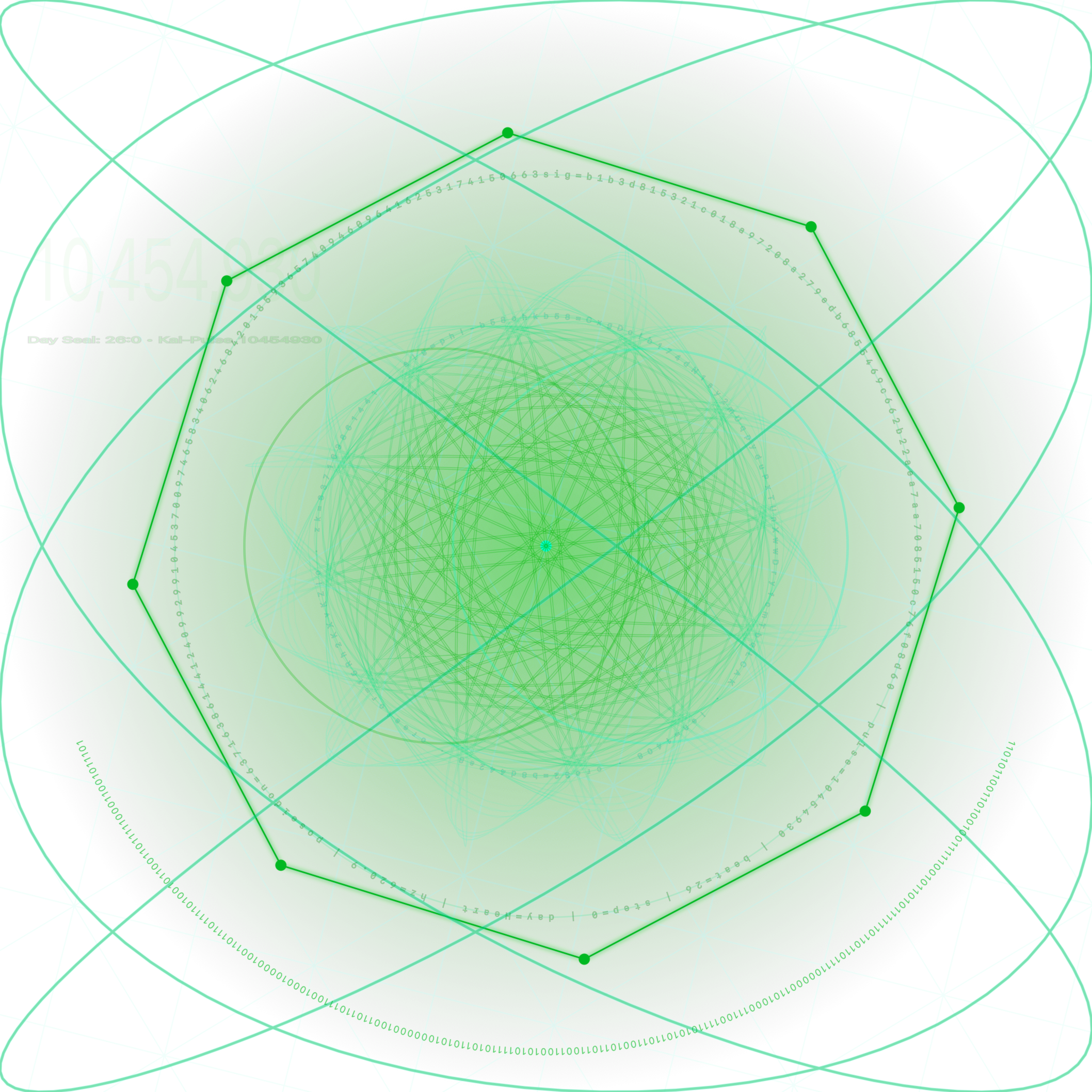
Record Payload (bundle + receipt JSON) Proof Bundle
{”bundleHash”:”7f31aecf9a581230c1c2ccda10c9ae81ae3196fae7ecdd9869ce2d135c5df5aa”,”cacheKey”:”kvb:831ac4a94f59f50cc356b60c5997a00021b3acc0657a39abb45521de76f5c1ed”,”canon”:”JCS”,”capsuleHash”:”dd32f98cda7e7c28cd51e5069cf541c55cfa6f8a309fdabb53903837edb59c01”,”hashAlg”:”sha256”,”ownerPhiKey”:”15Rh2KXvKZiouyPDkBUHqHoLZHqWmte8vr”,”proofCapsule”:{”chakraDay”:”Heart”,”kaiSignature”:”d6693e5afdb783473d5b2d995eb5026dc884dde966f8cbb6133e788cbcc3ce95”,”phiKey”:”15Rh2KXvKZiouyPDkBUHqHoLZHqWmte8vr”,”pulse”:10454930,”v”:”KPV-1”,”verifierSlug”:”10454930-d6693e5afd”},”proofHints”:{”api”:”/api/proof/sigil”,”explorer”:”/keystream/hash/6371638614412409929910453700974658340624684201859365740946096416253174150663”,”scheme”:”groth16-poseidon”},”receipt”:{”bundleHash”:”7f31aecf9a581230c1c2ccda10c9ae81ae3196fae7ecdd9869ce2d135c5df5aa”,”v”:”KVR-1”,”valuation”:{”mode”:”origin”,”phiValue”:4.82038909074263,”source”:”live”,”usdPerPhi”:139.632041644,”usdValue”:673.0807702588581,”v”:”KVS-1”,”verifiedAtPulse”:10455021},”valuationHash”:”09ee34a916cc0ee91c5035f8f12b6310b1c285991cc328a4e9115db04645b0ad”,”verificationVersion”:”KVB-1.2”,”verifiedAtPulse”:10455021,”verifier”:”local”,”zkPoseidonHash”:”6371638614412409929910453700974658340624684201859365740946096416253174150663”},”receiptHash”:”02f68ab8f1e637081224cb1675c74f4fbfa3f3692842dd666c5d662ea633ea46”,”shareUrl”:”https://phi.network/s/b1b3d815321c018a97208a279edb6855469c662b22aea7aa7085150c76f08d60?p=eyJwdWxzZSI6MTA0NTQ5MzAsImJlYXQiOjI2LCJzdGVwSW5kZXgiOjAsImNoYWtyYURheSI6IkhlYXJ0Iiwic3RlcHNQZXJCZWF0Ijo0NCwidXNlclBoaUtleSI6IjE1UmgyS1h2S1ppb3V5UERrQlVIcUhvTFpIcVdtdGU4dnIiLCJrYWlTaWduYXR1cmUiOiJkNjY5M2U1YWZkYjc4MzQ3M2Q1YjJkOTk1ZWI1MDI2ZGM4ODRkZGU5NjZmOGNiYjYxMzNlNzg4Y2JjYzNjZTk1In0”,”svgHash”:”a702a56a3ba8e3d87d0c264e1acf3955719028fd7975ad7ef003c69eea92bbaa”,”verificationCache”:{”bundleHash”:”7f31aecf9a581230c1c2ccda10c9ae81ae3196fae7ecdd9869ce2d135c5df5aa”,”cacheKey”:”kvb:831ac4a94f59f50cc356b60c5997a00021b3acc0657a39abb45521de76f5c1ed”,”createdAtMs”:1770066749618,”expiresAtPulse”:null,”v”:”KVC-1”,”verificationVersion”:”KVB-1.2”,”verifiedAtPulse”:10455021,”verifier”:”local”,”zkPoseidonHash”:”6371638614412409929910453700974658340624684201859365740946096416253174150663”},”verificationVersion”:”KVB-1.2”,”verifiedAtPulse”:10455021,”verifier”:”local”,”verifierUrl”:”https://phi.network/verify/10454930-d6693e5afd-10455021”,”zkPoseidonHash”:”6371638614412409929910453700974658340624684201859365740946096416253174150663”,”zkProof”:{”curve”:”bn128”,”pi_a”:[”18763878429126800206806343805797990926020781524791417404855421092985089620509”,”15535451588746595913659511405249251176761568175353859309518732846536316142691”,”1”],”pi_b”:[[”5249262728119892030904506756656357768764932889293595184495967723449118253295”,”11623566822681655591231169213907221688290649812432918878104458271144049619800”],[”1967831783657251387828841030906118122420800653404191339724907433406376368272”,”18727654471768533252492161097875852894142135679409545301376744311448232700148”],[”1”,”0”]],”pi_c”:[”20769347510503298959636591458441173468584462186995299527088148212722596929218”,”9423353305206456252431709435449801821029944478460806861929346490358603307882”,”1”],”protocol”:”groth16”},”zkPublicInputs”:[”6371638614412409929910453700974658340624684201859365740946096416253174150663”,”6371638614412409929910453700974658340624684201859365740946096416253174150663”],”zkScheme”:”groth16-poseidon”,”zkVerified”:true}